

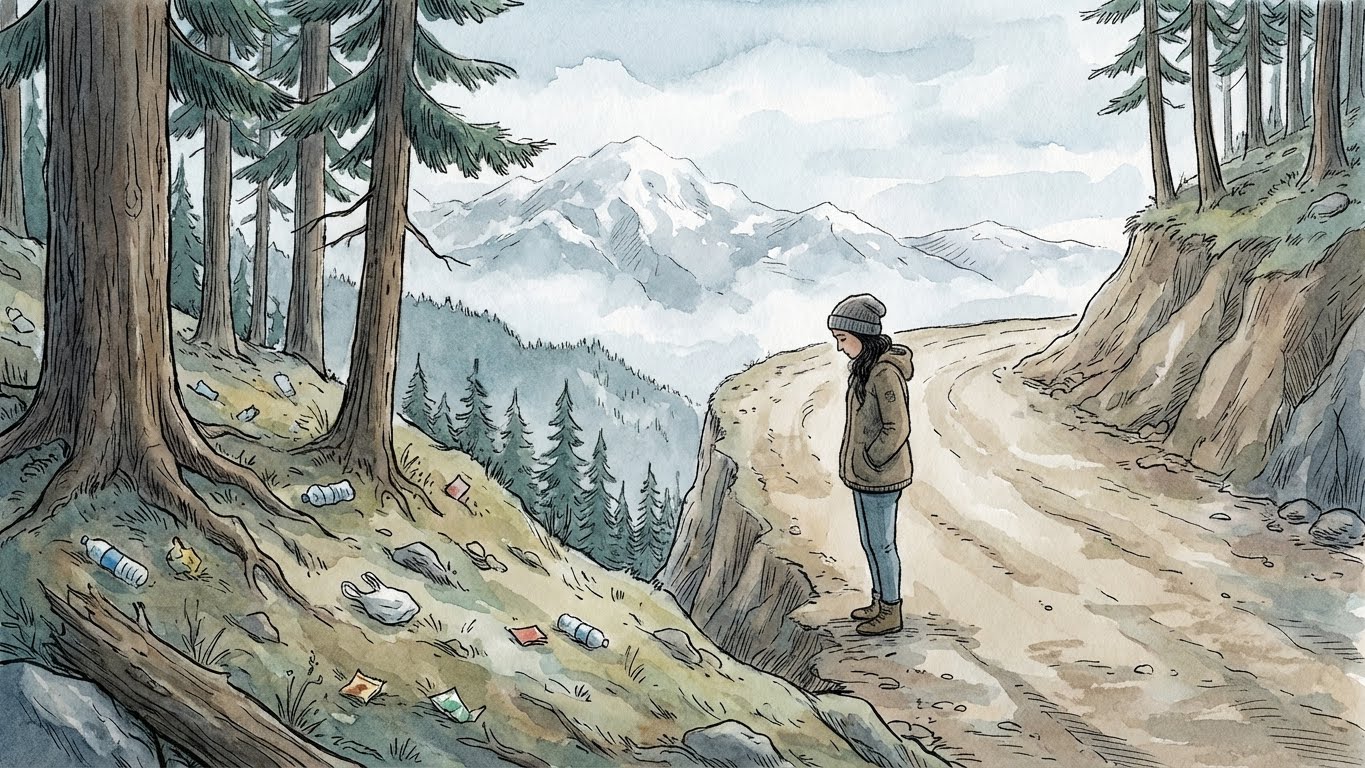
(A personal field report from someone who just moved in.)
I was so happy to move to Manali for work. Honestly, I was over the moon. You know how much I love deodar trees. I love the ones in Shimla, Narkanda, and my hometown, Nankhari, too. I just can’t get enough of them. But living here made me confront the waste management situation in Manali in ways I didn’t expect.

So moving to a place surrounded by these gentle, tall trees felt like coming home. But after a week, I noticed something interesting. The deodars are everywhere. The dustbins? Missing. And slowly, I started realising why people keep talking about waste management in Manali.
Day 1: The Hope Phase
We packed all our trash neatly in one bag, thinking we’d find a dustbin during an evening walk, just like you sometimes find a momo stall by accident.
But the only things we found were:
- Two cafés
- A herd of cows
- Another café
- One aunty selling socks
- And exactly zero dustbins
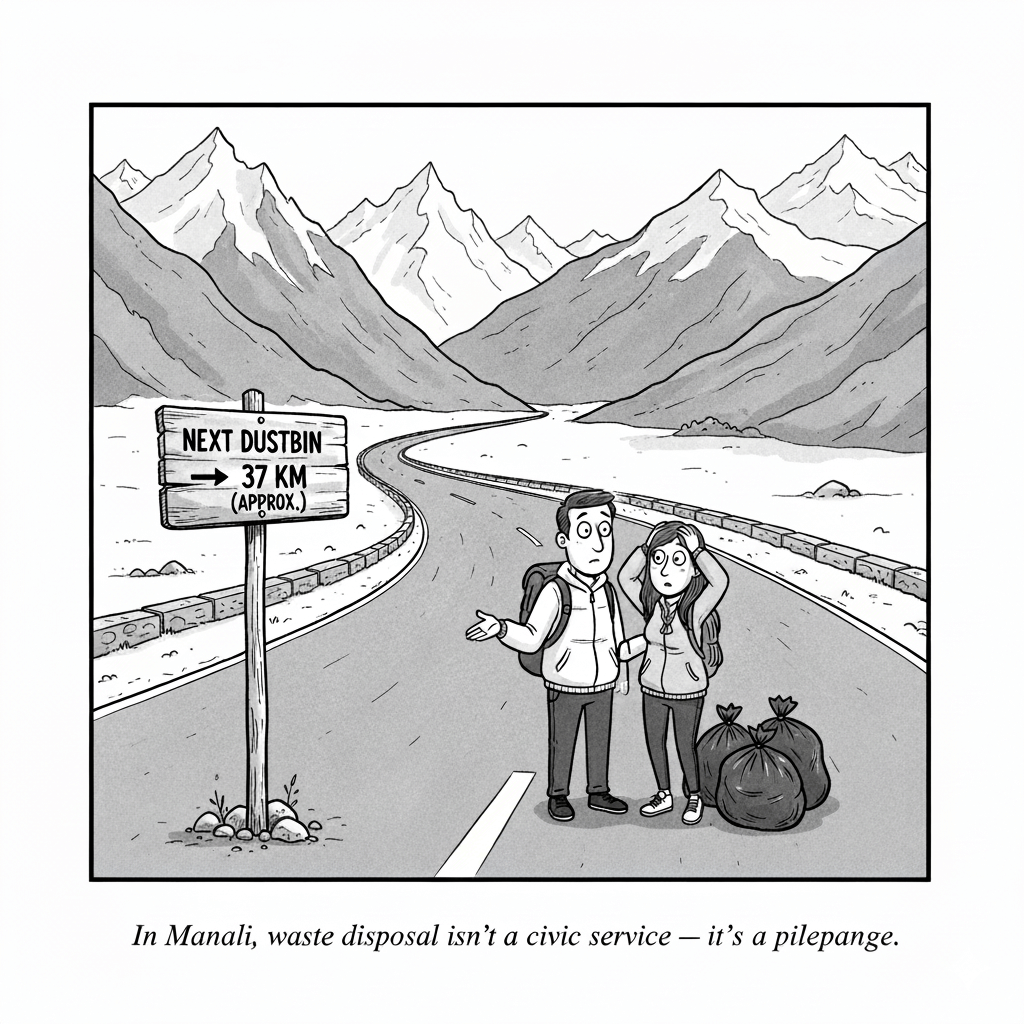
Still, we weren’t worried. “It’s okay, we will find one tomorrow,” we said. That optimism lasted 24 hours.
Day 3: The Realisation Phase (Understanding Waste Management in Manali)
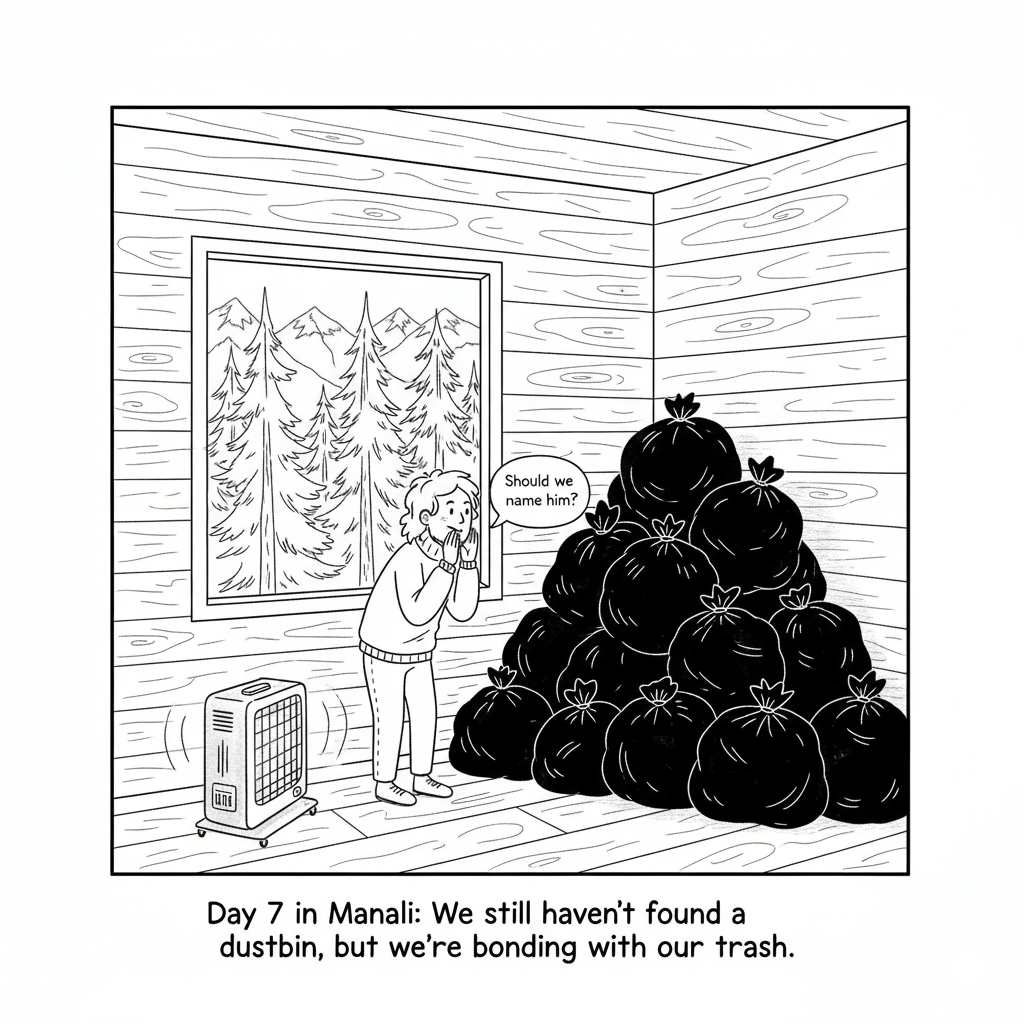
By Day 3, our “small garbage bag” had grown into a full-fledged family member. It sat in the living room like a guest we were too polite to ask to leave.
At one point, Surya looked at it and said, “Should we give him a name?” Absolutely not. But also… maybe yes.
Day 5: The Spiritual Phase
We finally decided to take the car and go on an official dustbin hunt.
It felt like a safari, but instead of searching for wildlife, we were scanning the roadsides for blue bins like desperate detectives.
Manali has:
- A scenic viewpoint every 200 metres
- Apple orchards every 400 metres
- Adventure sports every 1 km
- Cafés every 100 metres
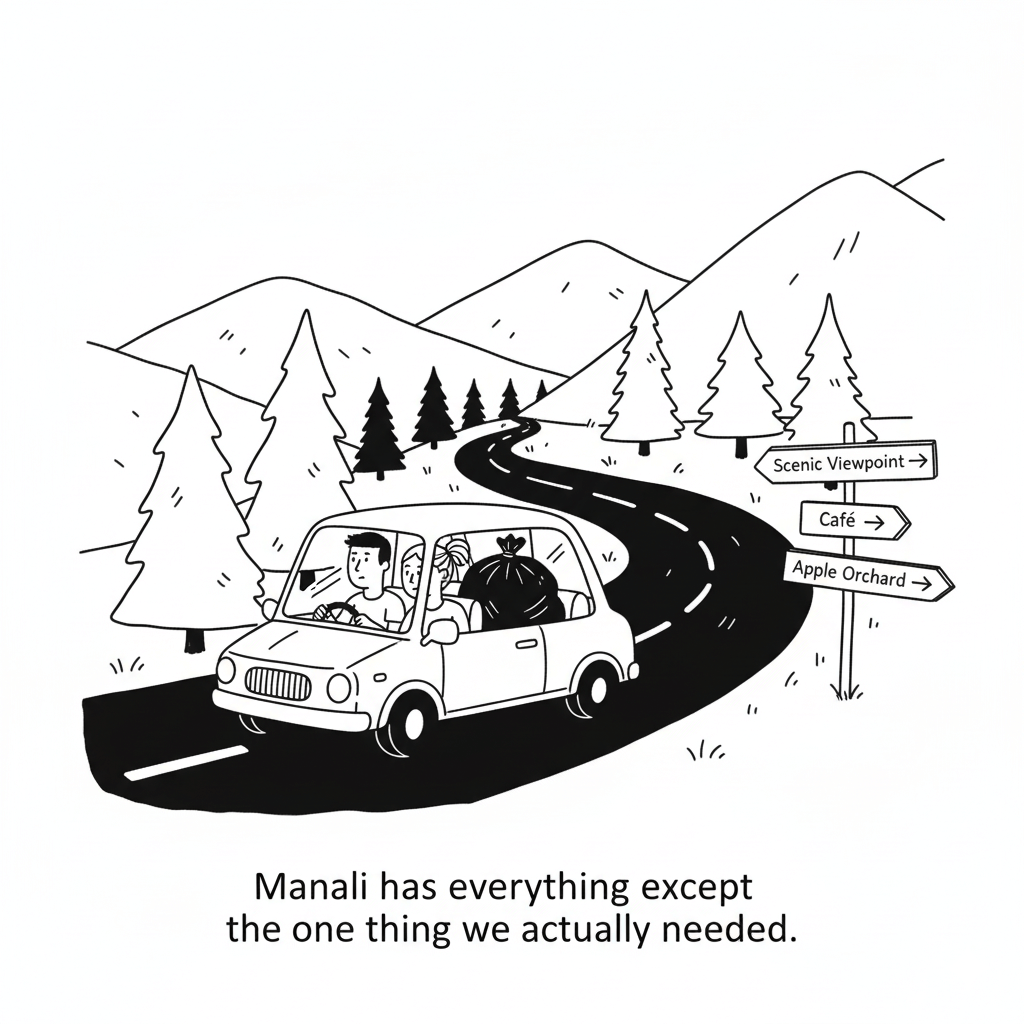
But dustbins? They might as well be in another dimension. By the end of the drive, we had seen half of the Kullu district, but returned home with the same garbage we left with, which explains why Manali waste disposal feels almost impossible right now.
A Little Reality Check
Turns out, we are not the only ones driving around Manali with a garbage bag as a co-passenger. Even the National Green Tribunal recently called out the Himachal government for the magnitude of the Kullu Manali waste problem. A viral video showing piles of garbage made them take suo motu action. Things are so bad that both the High Court and NGT are monitoring the issue at the same time, like two strict parents keeping an eye on a very irresponsible child. Which basically means: if I can’t find a dustbin, it’s not my fault. It’s officially a matter for the courts.
The Larger Problem (A Not-So-Funny Part)
It’s easy to joke about our personal trash pilgrimage. But the missing dustbin problem isn’t just a quirk; it’s a symptom of a bigger solid waste issue in Kullu-Manali.
When locals and tourists don’t have a place to dispose of waste, three things happen:
- People burn trash. (Everyone loses.)
- People dump it along rivers. (The rivers lose.)
- People carry it back home and hope for a miracle. (We lose.)
Manali’s beauty is fragile. The mountains can survive landslides and snowfall, to an extent, but not plastic wrappers that will outlive all of us.
So… What Do You Do With Kooda in Manali?
Honestly? At this point, keep it with you until you find a designated dump site. Because the alternative is letting the mountains pay for our convenience, and that’s not happening on my watch.
And maybe that’s where the real solution starts, not with long awareness campaigns or twenty-page reports, but with locals asking the simplest question: “Dustbin kahan hai?” If enough people ask, someone in authority will have to answer. Until then, we will do what we always do: carry our kooda, protect our mountains, and hope the system catches up with the people who actually live here.
Until then, I will keep taking my garbage out for long scenic drives. He enjoys the fresh air. Manali may be heaven on earth, but please bring your own dustbin.